
Why E-Commerce is Broken, and How Agentic Commerce Fixes It
The traditional e-commerce flow hasn’t fundamentally changed in nearly two decades. Brands are stuck accepting a measly 2-3% conversion rate. Agentic commerce stands to replace this broken e-commerce model to drive better results for shoppers and retailers. Here we’ll break down why traditional e-commerce storefronts are failing and why agentic commerce is rising up to take its place.
Most E-Commerce Brands Still Struggle to Drive Conversions and Deliver Great UX
Even top brands suffer from high bounce rates, low conversions, and an underwhelming user experience. Why? They tend to rely on:
- Ads optimized for clicks, not experience
- Static PDPs overloaded with information
- FAQ sections that go unread
- Search bars and filters that miss context
- Passive chatbots that wait for engagement
- Analytics and A/B testing tools only give incremental improvements
Retailers overwhelm shoppers with choices, but fail to guide them to the right decision and drive the sale—despite having access to more customer insights than ever. The burden ultimately rests on every shopper to research and find what they want. When they can’t, they bounce… or increasingly, they use AI.
Agentic Commerce: New E-commerce Shopping Behaviors and Expectations
Fed up with poor online shopping experiences, consumers are turning to genAI assistants like ChatGPT, Gemini, and Perplexity to help them shop, bypassing traditional search and endless browsing across PDPs altogether. Adobe reported a 1200% increase in generative AI-driven traffic to retail sites just since July of 2024.
Traditional Search vs. Agentic Commerce Search
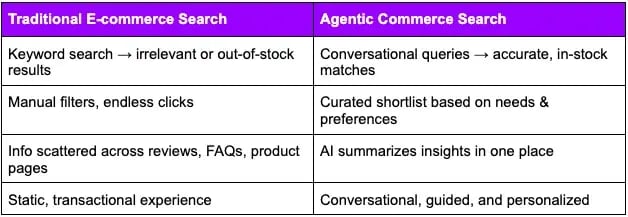
The shift makes sense, consumers want instant, curated results with less effort.
Traditional storefronts can’t deliver that. But ahead-of-the-curve retailers implementing agentic commerce tactics can, and they’re already starting to.
Agentic Commerce Drives Bigger, Faster Wins for Retailers
 AI shopping agents anticipate intent, personalize results, and guide the shopper like a trusted advisor. Agentic commerce succeeds where traditional e-commerce fails: turning browsing into buying.
Children’s furniture brand Mon Lit Cabane rolled out an
AI shopping assistant on product pages to help proactively
guide parents to the right piece of furniture. The impact?
- Engagement on PDPs skyrocketed
- Post-conversation conversions hit 8%
- Average order value rose 30%
- More than €1M in incremental revenue was generated
in just three months
…and this is just one of many examples.
When retailers stop making shoppers do all the work, and instead guide them with AI-backed confidence, the shopping experience becomes a win-win.
Three Takeaways for E-Commerce Leaders
1. Stop relying on the browse-and-hope model.
PDPs need to be proactive decision engines, not static brochures. Reframe your highest-intent pages as guided experiences that anticipate and curate to go from doubt to purchase more seamlessly.
2. Get your data ready for agentic commerce.
To be discoverable by AI agents, retailers must structure product data, enable secure APIs, and implement “agentic SEO” so their catalog can be indexed and surfaced in conversational queries. Forward-looking brands are already making LLM optimizations today to prepare for agent-driven transactions.
3. Launch fast, learn faster.
Retailers don’t need to rebuild from scratch: they can launch an AI storefront with iAdvize, run an agentic readiness assessment, quickly launch an AI shopping assistant, and learn from early results to scale fast.
AI Storefronts as the Next Frontier of E-Commerce
The next era of commerce won’t start with a search bar but with an AI agent. And if your brand isn’t visible to agents, it won’t be visible to customers.
Agentic commerce isn’t a trend. It’s a structural shift redefining how products are discovered, evaluated, and purchased. As PayPal’s CEO predicted, 25% of e-commerce spend could be agent-driven by 2030, and the retailers that move first won’t just capture higher conversions and new revenue streams, they’ll set the standards everyone else will follow.
The good news is you don’t need to rebuild from scratch. Getting started is fast. An agentic commerce readiness assessment can help you benchmark where you stand today and map the fastest path to launch your AI storefront.
Talk to our team