
How To Prepare for Agent-to-Agent Commerce
Agent-to-agent commerce is coming. As artificial intelligence continues to advance, we're moving toward a future where AI agents—not humans—will be the primary drivers of e-commerce transactions.
For retailers, this represents both an enormous opportunity and a significant challenge. If you're not preparing now, you risk being left behind.
What Is Agent-to-Agent Commerce?
Agent-to-agent commerce refers to transactions conducted between artificial intelligence agents.
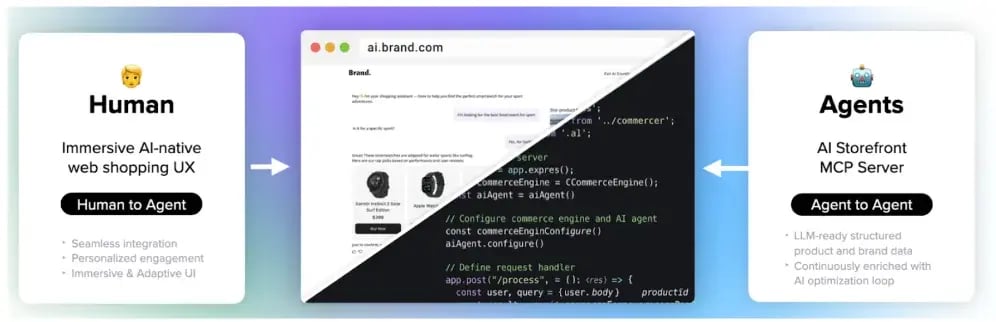
In this model, AI shopping agents act as buyers, interacting with AI seller agents (or storefronts) to discover products, negotiate terms, and complete purchases—all without direct human intervention.
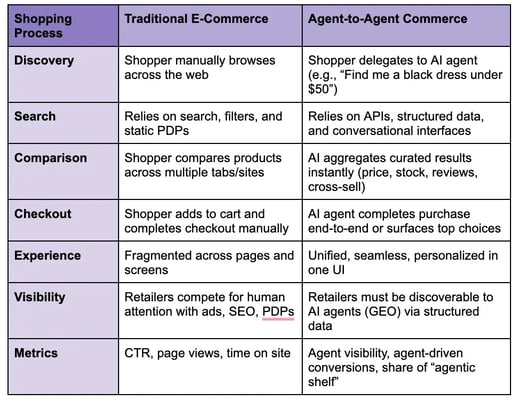
This is fundamentally different from how e-commerce works today.
Currently, humans browse storefronts, compare products, read reviews, and make purchasing decisions. In agent-to-agent commerce, AI agents do all of this automatically.
These agents can:
-
Learn individual preferences and adapt purchasing behavior over time
-
Compare products across multiple retailers instantly
-
Negotiate prices and terms
-
Process transactions autonomously
-
Provide feedback to improve future interactions
Example: A Wedding Shopping Scenario
To understand how agent-to-agent commerce works, consider this example:
Sarah is planning her wedding. Instead of spending weeks researching venues, caterers, florists, photographers, and decorators, she sets up an AI shopping agent with her preferences, budget, guest count, and wedding date.
Her agent then:
-
Contacts multiple venue agents simultaneously
-
Negotiates availability and pricing
-
Requests quotes from catering agents based on her menu preferences
-
Compares florist options and pricing
-
Books a photographer based on style preferences and availability
-
Coordinates all bookings to ensure alignment
Meanwhile, each vendor’s AI agent is:
-
Responding to multiple buyer agents
-
Providing real-time availability and pricing
-
Negotiating terms
-
Processing payments
-
Updating inventory and schedules in real-time
The entire process —which would normally take weeks of human research and negotiation— is completed in minutes or hours.
Sarah’s agent coordinates across all vendors, ensures everything is scheduled correctly, and provides her with a comprehensive summary of all bookings and pricing.
This is agent-to-agent commerce in action.
How AI Shopping Agents Interact With Each Other and Shoppers
Agent-to-agent commerce works by connecting richly structured data, secure transaction APIs, and orchestration layers that allow AI agents to “talk” directly to storefronts based on what a customer has sent them to shop for.
With every product attribute (size, color, price, availability, compatibility, materials, reviews, etc.) served in a standardized format (like JSON, XML, etc.), AI agents can query, compare, and qualify products without human intervention.
AI shopping assistants or “agents” could come in various forms:
Generative AI Platform Shopping Companions
Perplexity, Gemini, and ChatGPT all have shopping capabilities built in. Users can ask these agents to find products, compare prices, and make recommendations. As these agents become more sophisticated, they’ll be able to complete purchases autonomously.
Voice Assistants
Alexa, Google Assistant, and Siri are already being used for some shopping tasks. As these assistants become smarter and more capable, they’ll handle more complex purchasing workflows.
Multi-Agent Systems Within Single Storefronts
Some forward-thinking retailers are already experimenting with multi-agent systems. These systems use multiple AI agents working together to personalize the shopping experience, answer customer questions, manage inventory, and process orders.
The transition from today’s human-driven e-commerce to agent-to-agent commerce won’t happen overnight.
But it’s already beginning. Retailers that understand these trends and prepare accordingly will be best positioned to thrive in the future.
How Retailers Need to Prepare for Agent-to-Agent Commerce
If you’re a retailer, the question isn’t whether agent-to-agent commerce will happen—it’s whether you’ll be ready when it does. Here’s how to prepare:
1. Structure Your Product Data
AI agents need clean, consistent, structured product data to make intelligent purchasing decisions. This means: - Complete product information (features, specifications, images, pricing) - Consistent data formats across all products - Accurate inventory tracking - Regular data quality checks and updates - Integration with your product information management (PIM) system
Your current storefront might be designed for human browsing, but AI agents need machine-readable data. If your product data isn’t properly structured, AI agents won’t be able to effectively interact with your storefront.
2. Enable Secure Transactions
Agent-to-agent commerce requires automated transactions. This means your payment processing needs to be: - API-enabled for machine-to-machine transactions - Secure and encrypted - Capable of handling micro-transactions - Integrated with fraud detection systems - Compliant with relevant regulations
You’ll also need to consider new security challenges. How do you verify that the agent making a purchase is authorized to do so? How do you prevent fraudulent transactions by compromised agents?
3. Move to an AI Storefront
Your current storefront is designed for human visitors. An AI storefront is designed for machine interaction. This means: - APIs that AI agents can interact with directly - Machine-readable product catalogs - Automated response to agent queries - Real-time inventory management - Flexible pricing and negotiation capabilities
This doesn’t mean your human-facing storefront goes away. Instead, you’ll have both: a human-friendly storefront for browsing, and an AI-friendly API for agent interaction.
4. Start Training Your AI Shopping Assistant
If you’re going to compete in the agent-to-agent commerce space, you need your own AI assistant.
This assistant should:
-
Learn your products inside and out
-
Understand your shoppers’ needs and preferences
- Respond intelligently to every query
-
Handle negotiations and pricing discussions
-
Process transactions securely
The earlier you start training your AI assistant, the more sophisticated it will be when agent-to-agent commerce becomes mainstream.
5. Track New Traffic Types
As agent-to-agent commerce grows, you’ll see new types of traffic:
-
Machine-to-machine API calls from buyer agents
-
Automated product queries and comparisons
-
Bot-driven negotiations and transactions
-
Bulk purchases from aggregator agents
Your analytics need to evolve to track these new traffic types.
You need to understand:
-
How many transactions are being driven by agents vs. humans
-
Which products are most popular with agents
-
What pricing and terms agents are negotiating for
-
How agent-driven traffic converts differently than human traffic
6. Incorporate Agentic SEO Practices
SEO has always been about helping humans find your storefront. Agentic SEO is about helping AI agents discover and interact with your products.
This includes:
-
Structured data markup (Schema.org, JSON-LD)
-
API documentation and accessibility
-
Clear product information and specifications
-
Transparent pricing and availability
-
Response times and reliability metrics
The Next Era Belongs to Agent-to-Agent Commerce
Agent-to-agent commerce is not a distant future concept—it’s already beginning.
The AI shopping assistants, voice commerce, and multi-agent systems we see today are the early stages of a fundamental shift in how e-commerce works.
Retailers that begin preparing now—by structuring their data, enabling secure APIs, training AI assistants, and adapting their SEO strategies—will be best positioned to thrive in the agent-to-agent commerce era.
The question isn’t whether agent-to-agent commerce will happen. The question is: will you be ready?
Talk to our team