
/blog%20post/Header%20background_article.webp?width=1520&height=500&name=Header%20background_article.webp)
What the AI Storefront Looks Like and Why It Converts Better
Sommaire
The traditional e-commerce flow hasn’t fundamentally changed in nearly two decades. Brands are stuck accepting a measly 2-3% conversion rate. Agentic commerce stands to replace this broken e-commerce model to drive better results for shoppers and retailers. Here we’ll break down why traditional e-commerce storefronts are failing and why agentic commerce is rising up to take its place.
Let’s say a shopper goes to a skincare retailer hoping to build a routine. In today’s world, they take a generic quiz that emails the results, get shown products that are sold out, or browse around aimlessly on PDPs.
But soon, they’ll be pulled into a new type of storefront that can instantly build them a curated regimen based on their budget, skin concerns, and favorite ingredients. Their most specific questions get answered not with canned responses but real expertise, reviews, visuals and key details surfaced at the right time. They check out seamlessly, set up a subscription, and come back for more. The storefront builds on their history instead of starting from scratch—all from the same place.
This is the promise of the AI storefront, where shoppers can depend on AI to suggest and make key buying decisions with minimal input and effort—and it’s the next evolution in agentic commerce.
The Traditional E-Commerce Experience: Where Friction Begins
Before we dive into AI storefronts, let’s understand the limitations of today’s standard online shopping experience.
When a shopper arrives at a traditional e-commerce storefront, they’re greeted with:
- Homepage Design: A static layout featuring promotional banners, category navigation, and featured products
- Search & Browse: Limited navigation options—either using search (which requires knowing what they want) or browsing categories (which requires time and effort)
- Product Pages: Static information with images, descriptions, specs, and customer reviews
- Recommendations: Basic algorithmic suggestions (“Customers also bought…”) that lack context
- Checkout: A multi-step process that asks for information the shopper has already provided
This approach works reasonably well for shoppers who know exactly what they’re looking for. But for the vast majority of shoppers—those exploring options, comparing alternatives, or seeking personalized guidance—the experience is friction-filled and often leads to abandonment.
Consider a common scenario: A shopper visits a skincare storefront looking to address fine lines around their eyes. With a traditional e-commerce approach, they might:
- Land on the homepage (generic welcome experience)
- Search for “eye cream” (requires them to know the category)
- See 50+ product options (overwhelming choice)
- Read multiple product descriptions (time-consuming)
- Check reviews and compare (more time investment)
- Finally select a product (after significant friction)
The process is exhausting, and many shoppers abandon before making a purchase.
The AI Storefront Experience: Personalized Guidance at Scale
Now imagine the same scenario with an AI Storefront:
A shopper arrives and immediately sees a conversational interface (AI Shopping Assistant) that greets them warmly: “Hi! I’m here to help you find exactly what you need. Tell me a bit about your skincare goals—what brings you here today?”
The shopper responds: “I’m looking for something for fine lines around my eyes. I have sensitive skin and prefer natural ingredients.”
The AI, powered by advanced natural language understanding, immediately:
- Understands their specific concern (fine lines around eyes)
- Captures their skin type (sensitive)
- Notes their preference (natural ingredients)
- Filters the product catalog in real-time
- Presents 2-3 personalized product recommendations with specific reasoning: “Based on what you’ve shared, I think [Product X] would be perfect for you because it’s specifically formulated for sensitive skin and contains [natural ingredient Y] which is known for reducing fine lines.”
The shopper can ask follow-up questions: “Does it have any fragrance?” or “How long does a jar last?” The AI answers immediately with accurate product information, addressing specific concerns before they become objections.
When the shopper is ready to purchase, the AI facilitates a smooth transition to checkout—often with one-click purchasing, since the shopper has already shared the information needed to complete the transaction.
The entire experience takes minutes instead of the 15-30 minutes a traditional e-commerce shopper journey might require. More importantly, the shopper feels understood, guided, and confident in their purchase decision.
Key Differences: Chatbots vs. AI Shopping Assistants vs. AI Storefronts
Before we go deeper, it’s important to clarify three distinct concepts that are often confused:
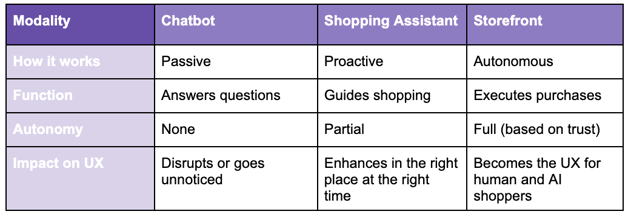
- Chatbots: Customer service tools designed to answer questions, resolve issues, and handle support inquiries. They’re reactive—shoppers must initiate contact and ask for help.
- AI Shopping Assistants: Conversational interfaces designed to help shoppers find products and make recommendations. They proactively guide shoppers through the discovery process but operate within a traditional e-commerce framework.
- AI Storefronts: A complete reimagining of the online shopping experience where the conversational interface IS the primary way shoppers discover, explore, and purchase products. The entire storefront is organized around conversational commerce rather than traditional category/search navigation.
The distinction matters because it fundamentally changes the shopper experience and the business outcomes.
What Makes an AI Storefront Different?
The AI storefront offers a more engaging and effective experience across the shopping journey, unifying discovery, decision-making, and final checkout into one seamless, adaptive interface.
Here’s what shopping could feel like in an AI storefront:
Browsing drives a purchase—not more browsing.
A shopper says: “I’m looking for black short-sleeved turtleneck.”The storefront reshapes to show them a few
perfect picks, and explains why they’re a good fit.
Proactive prompts drive engagement and clarity.
The storefront proactively addresses FAQs and specific questions by pulling information across PDPs, blogs, reviews, and more. It offers one-click add to cart options and relevant upsells based on the interaction.
Finalize the sale and prepare for the next one all in one.
The browsing process, questions, shopping cart, add ons, check out and shipping happen in the same place—no tabs, no getting lost across pages and screens, no digging through email.
Improve the customer experience across visits.
The storefront adapts to their tastes, creating a unique customer profile and playbook for each person, instead of slotting them across a few generic ones.
(This video shares our vision of the experience to come, beyond the features available today.)
The UX Architecture of an AI Storefront
While AI storefronts can take many forms, most successful implementations share a common UX architecture:
- Welcome/Greeting Layer: An initial message that invites the shopper into conversation and sets expectations (“Hi! I’m here to help you find [product category]. How can I help today?”)
- Discovery Conversation: The shopper shares their needs, preferences, constraints, and concerns. The AI asks clarifying questions when needed to understand exactly what will satisfy the shopper.
- Recommendation Presentation: Based on the discovery conversation, the AI presents 2-3 personalized product recommendations with specific reasoning for each choice.
- Deep Dive: The shopper can ask follow-up questions about any recommendation. The AI answers with product-specific information, ingredients, sizing, care instructions, etc.
- Objection Handling: If the shopper expresses concerns (“That seems expensive” or “I’m worried about allergies”), the AI addresses the concern directly with relevant information or alternative suggestions.
- Purchase Decision: When the shopper is ready, the AI facilitates the purchase with minimal friction—ideally one-click or single-form completion.
- Post-Purchase: After purchase, the AI can provide care instructions, suggest complementary products for future visits, or set up reminders for reorders.
Key Benefits of AI Storefronts
Though AI storefronts are still taking shape, retailers can already set their sights and expectations on some clear benefits and capabilities:
Drive Engagement, Conversions, and Delight
- Adaptive, fluid interfaces pull from multiple sources to offer relevant recommendations in real time, transforming static PDPs into dynamic, personalized experiences.
- Proactive by design. The AI storefront doesn’t wait for clicks or searches; it anticipates intent and reshapes the journey, surfacing the right options, context, and guidance exactly when shoppers need them.
Boost Revenue with Smarter Sales Strategies

- All-in-one add-to-cart and cross-sell options to keep a customer in the same storefront conversation, instead of scattered across pages and tabs.
- Strategic decision-making abilities means storefronts can use context and reasoning to make better offers in real-time and employ the right sales tactics for each customer.
Expand Your Reach On Your Site and Across the Web
- Smart product discovery that replaces filters, ineffective search with natural language that makes all of your products easy to find.
- Well-structured metadata and attributes paired with agentic SEO (GEO) strategies ensure accuracy and visibility across human and AI-lead searches.
Maximize Existing Resources to Launch Quickly (and Safely)
- Fast storefront activation to launch in mere days while integrating seamlessly with your existing e-commerce stack, data inputs and outputs, and existing design and marketing standards.
- Data protection to ensure agents transact safely and transparently while accessing only the data they can and should and that customers opt in.
How to Implement AI Storefronts: Practical Steps for E-Commerce Leaders
If you’re considering implementing an AI storefront, here’s how to approach it:
- Define Your Shopper Journey:
Map out the typical shopper journey for your products. What questions do shoppers ask? What concerns do they have? What information do they need to make confident purchase decisions? This understanding should drive your AI storefront design. - Prepare Your Product Data:
AI storefronts depend on rich product data. Make sure you have detailed information about each product—ingredients, sizing, benefits, use cases, and care instructions. The better your product data, the better your AI can serve shoppers. - Choose the Right Technology Platform:
Select an partner that specializes in conversational commerce and can integrate with your existing e-commerce infrastructure. Look for platforms that support real-time personalization, product integration, and seamless checkout. - Start with a Pilot:
Rather than implementing across your entire catalog, start with a single category or product line. This allows you to test, learn, and optimize before scaling. - Monitor Key Metrics:
Track conversion rates, average order value, shopper satisfaction, and return rates. Compare these metrics between your traditional e-commerce experience and your AI storefront to validate that the new approach is working. - Iterate Based on Shopper Feedback:
Pay attention to the conversations shoppers are having. What questions are they asking? What objections are they expressing? Use this information to continuously improve your AI storefront. - Scale Gradually:
As you see success with your pilot, gradually expand the AI storefront to other categories and product lines.
The Future of E-Commerce
The AI Storefront represents a fundamental shift in how online shopping will work.
Rather than static storefronts with search boxes and category navigation, the future of e-commerce is conversational, personalized, and guided.
For shoppers, this means faster shopping journeys with greater confidence in their purchases.
For brands and retailers, this means higher conversion rates, higher average order values, lower return rates, and deeper shopper insights.
The transition from traditional e-commerce to AI storefronts is already underway.
The question for e-commerce leaders is not whether this shift will happen, but how quickly they can adapt to meet shoppers where they are—in conversation.



/blog%20post/CTA%20background_Ressource%20page.webp?width=1900&height=641&name=CTA%20background_Ressource%20page.webp)